9 Flight Training Delays in 2026 and How to Avoid Each
Published by:
Matthew Bourguignon
Published on:
Updated on:
Read time:
8 min read
You were on pace. Three lessons a week, landings coming together, and then a storm week, a work trip, and a missed medical appointment stacked up. When you got back in the airplane a month later, your first lesson back was all review. If you are asking why flight training is taking so long, that pattern is usually the answer.
Most flight training delays come from a short list of causes, and most of them are predictable. Some, like weather and aircraft inspections, cannot be removed, only planned around. The rest you can head off before they cost you weeks. Here are the nine we see most often, why each one adds time, and how to avoid each one.
If you want the full picture of how long training should take, start with our guide to how long it takes to get a private pilot license. On our realistic 65-hour plan at three lessons a week, that is about 13 weeks. This post is about what pushes you past that number.
The nine delays at a glance
You will meet these roughly in this order during your Private Pilot Certificate training.
| Delay | Why it adds time | How we help you plan around it |
|---|---|---|
| 1. Weather days | Lessons and solo flights cancel | Flexible slots and ground lessons as a backup |
| 2. Long gaps between lessons | Review flights, lapsed endorsements | A steady weekly schedule from day one |
| 3. Medical certificate delays | No solo until it is issued | Booking the exam in your first weeks |
| 4. Putting off the knowledge test | It becomes the last hurdle | Studying for it while you fly |
| 5. Pre-solo landing plateau | Extra pattern lessons | Focused landing practice, close together |
| 6. Inconsistent scheduling | Lost continuity and repeated briefings | A set plan with your instructor |
| 7. Unprepared lessons | The same lesson flown twice | Knowing the plan before you arrive |
| 8. Checkride scheduling | Waiting at the finish line | Planning the examiner date early |
| 9. Maintenance downtime | The airplane is in the hangar | Our own A&P mechanics and early squawks |
1. Weather days you cannot fly through
Weather is the delay nobody controls. Pop-up summer thunderstorms and low clouds can cancel a lesson, and your instructor makes the go or no-go call for safety. Solo flights are stricter still. As a student pilot flying solo, you need at least 3 statute miles of visibility in daylight, 5 at night, and the ground in sight the whole time.
How to avoid it: build a little flex into your week. If a morning is gray, a ground lesson can still move you forward, and an open backup slot can catch the flight later. Our weekend flight training guide shows how booking both days turns a cloudy Saturday into a Sunday lesson.
2. Long gaps between lessons that cost review time
This is the biggest one. New skills fade quickly between lessons, so after a two-week break your next lesson often starts with review. The longer the gap, the more review hours you pay for.
Gaps also run into a rule. Your solo endorsement has to be refreshed every 90 days by your instructor, so a long break after solo usually means flying with your instructor again before a fresh endorsement lets you go alone.
How to avoid it: we recommend flying two to three times a week. If money is what forces the gap, look at funding before you start. Financing is available to qualified applicants through Stratus Financial and Flight Training Finance, and our financing page explains the options. With no minimum billing, you also pay only for the time you fly.
3. A medical certificate that is not ready when you are
You can start lessons without a medical, but you need it, along with a student pilot certificate, before your first solo. A third-class medical from an Aviation Medical Examiner (AME) covers student and private pilot flying. Students who wait until solo is close can end up ready to fly alone and grounded by paperwork.
Most exams are routine. Sometimes, though, the examiner sends the application to the FAA for review, and the FAA can ask for more medical records. Pilots who do not meet the standard requirements may be able to get a special issuance, a time-limited FAA authorization that can come with extra evaluation. Either path can take time.
How to avoid it: book the exam in your first few weeks of lessons. If you have any medical history question, talk to an AME before you book, so any FAA review starts early. Our first 30 days guide shows where the medical fits.
4. Putting off the knowledge test until the end
The knowledge test, often called the written exam, is the FAA’s multiple-choice test on rules, weather, navigation, and systems. You need an instructor endorsement to take it and a passing result before your checkride. Students who save it for last can finish their flying and then sit on the ground studying.
Your passing result is good for a checkride for 24 calendar months, so taking it in the middle of training costs you nothing.
How to avoid it: study between lessons and take it well before the final stretch. Our guide to the written exam and how to pass it covers how to prepare. Our post on private pilot training milestones shows where it sits among the others.
5. A landing plateau before your first solo
Landings are where many students hit a pre-solo plateau. One day the flare feels right, the next a gusty crosswind makes every approach feel new. That is normal, and it is also where hours can pile up if lessons are spread thin.
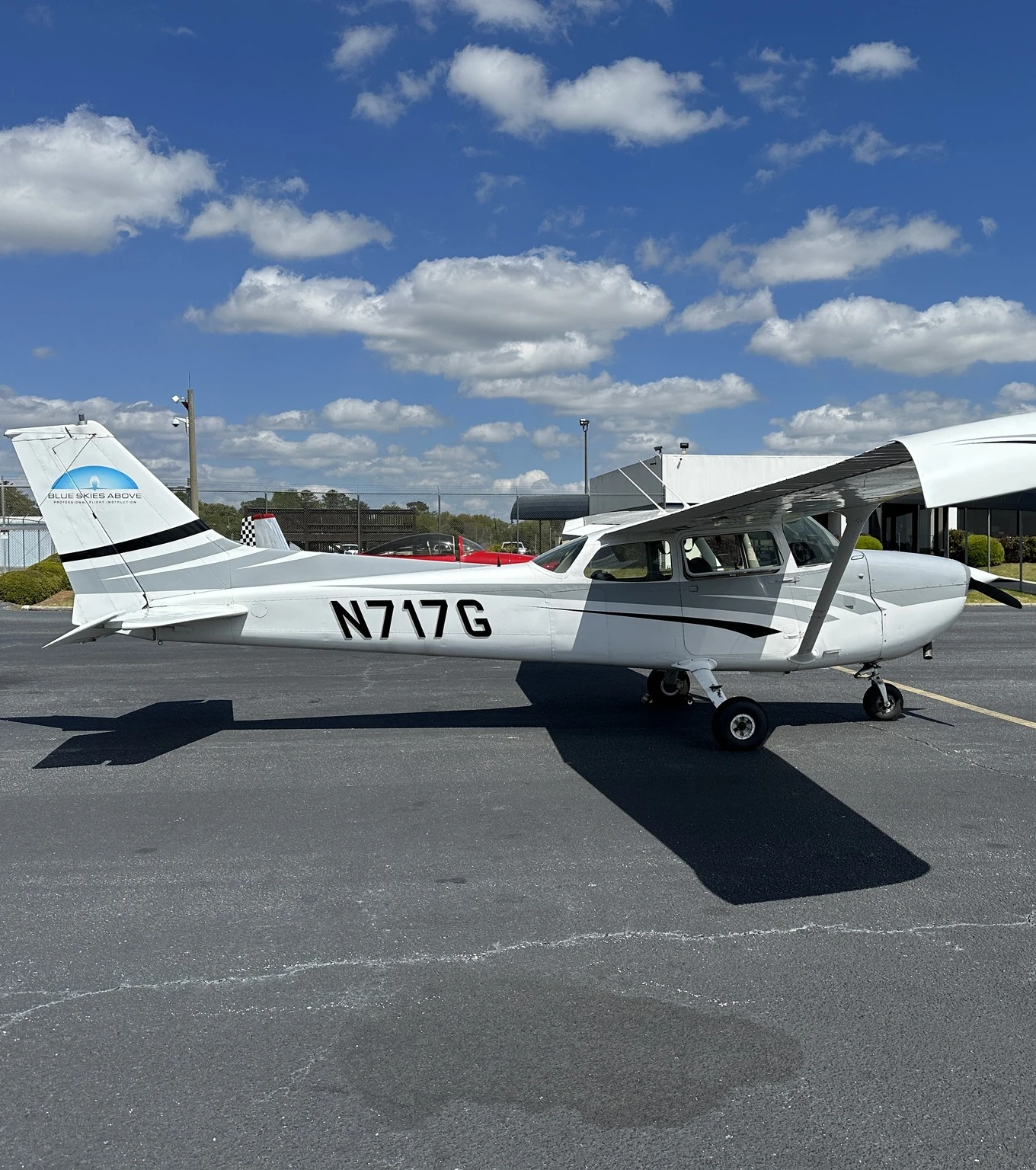
How to avoid it: fly your pattern lessons close together so each attempt builds on the last. Tell your instructor exactly what feels off, whether it is the flare or the crosswind correction, so the next lesson targets it. Our post on why we train in the Cessna 172 explains why its stable, predictable handling suits new pilots working on landings.
6. Scheduling that changes every week
When your lesson days, airplane, or instructor change from week to week, continuity slips. Each lesson starts with more catching up, and open slots get harder to find on short notice.
How to avoid it: here at Blue Skies Above, you are paired with a Certified Flight Instructor and build a plan around your goals and availability. Lock in recurring days early, treat them like appointments, and give notice when your week changes. You can meet our instructors on our team page. Contact us to set a schedule that fits your week.
7. Showing up to a lesson unprepared
Every lesson has a plan. If you arrive without knowing it, the briefing turns into teaching and the flight covers less. Sometimes the same lesson has to be flown twice.
How to avoid it: know the next lesson’s topic, read the material your instructor assigns, and bring your questions. Staying consistent and studying regularly is the simple version. Our tips on making the most of your ground lessons help you turn study time into shorter flights.
8. Waiting on a checkride date
The checkride is the FAA practical test, given by a Designated Pilot Examiner (DPE), an examiner the FAA appoints. Examiner availability varies with location, demand, and the examiner’s authorization, so a date is not always open the week you feel ready.
The final stretch also has a clock. You need 3 hours of checkride prep in the two calendar months before your test, and your instructor’s endorsement must show training in that same window. If the date slides too far, you fly more prep to stay sharp and current.
How to avoid it: have your medical, written test, and logbook items done early so the only thing left is the flying. Your instructor plans the examiner date as you near the standard. Our milestones guide shows how that last stretch lines up.
9. Maintenance downtime on the airplane
Airplanes used for flight instruction go through regular inspections, including 100-hour inspections, on top of any repairs, and an airplane in the hangar cannot fly your lesson.
How to avoid it: report anything that seems off after a flight right away, so maintenance can plan the fix. Here at Blue Skies Above, our own A&P mechanics maintain our fleet, which you can see on our fleet page. Inspections still take time, so keep a little flexibility in your schedule.
Flight Training Delays: FAQ
Why is my flight training taking so long?
Most often it is gaps between lessons, followed by weather and paperwork that started late. Flying two to three times a week keeps review short. Our timeline guide shows how pace changes the total.
What slows down pilot training the most?
Long gaps. They add review hours and can let your 90-day solo endorsement lapse. See our pricing page for how our plans are built around a steady pace.
Can weather delays be avoided?
No, but they can be planned around with flexible slots and ground lessons on bad days. Our weekend training guide shows one way.
When should I get my medical?
In your first few weeks, well before solo. If you have a medical history question, talk to an AME first. Our first 30 days guide shows the timing.
Does my written test expire?
Your passing result is good for a checkride for 24 calendar months. Our written exam guide covers preparation.
Start Your Training With a Plan That Expects Delays
The best time to plan around delays is before lesson one. On a Discovery Flight, you take the controls of a Cessna 172 with an instructor at Lanett Municipal Airport, then talk through a weekly schedule, your medical timing, and a backup plan for weather days.
Book your Discovery Flight and start training with a schedule built to keep moving.